
The deadline for the 2026 Grant applications is April 17, 2026. Successful applicants will be notified no later than May 30, 2026.
The Chemical Structure Association (CSA) Trust is an internationally recognized organization established to promote the critical importance of chemical information to advances in chemical research. In support of its charter, the Trust has created a unique Grant Program and is now inviting the submission of grant applications for 2026.
Purpose of the Grants:
The Grant Program has been created to provide funding for the career development of young researchers who have demonstrated excellence in their education, research or development activities that are related to the systems and methods used to store, process and retrieve information about chemical structures, reactions and compounds. One or more Grants will be awarded annually up to a total combined maximum of ten thousand U.S. dollars ($10,000). Grantees have the option of payments being made in U.S. dollars or in British Pounds equivalent to the U.S. dollar amount. Grants are awarded for specific purposes, and within one year each grantee is required to submit a brief written report detailing how the grant funds were allocated. Grantees are also requested to recognize the support of the Trust in any paper or presentation that is given because of that support.
Who is Eligible?
Applicant(s) in the early stages of their career who have demonstrated excellence in their chemical information related research and who are developing careers that have the potential to have a positive impact on the utility of chemical information relevant to chemical structures, reactions, and compounds, are invited to submit applications. Applicants must be within five years of obtaining their PhD. Note that proposals from those who have not received a Grant in the past will be given preference. While the primary focus of the Grant Program is the career development of young researchers, additional bursaries may be made available at the discretion of the Trust. All requests must follow the application procedures noted below and will be weighed against the same criteria.
Which Activities are Eligible?
Grants may be awarded to acquire the experience and education necessary to support research activities, e.g., for travel to collaborate with research groups, to attend a conference relevant to one’s area of research (including the presentation of an already-accepted research paper), to gain access to special computational facilities, or to acquire unique research techniques in support of one’s research. Grants will not be given for activities completed prior to the grant award date. Funding for 2026 will not be extended beyond December 31, 2026.
Application Requirements:
Applications must include the following documentation:
- A letter that details the work upon which the Grant application is to be evaluated as well as details on research recently completed by the applicant.
- The amount of Grant funds being requested and the details regarding the purpose for which the Grant will be used (e.g., cost of equipment, travel expenses if the request is for financial support of meeting attendance, etc.). The relevance of the above-stated purpose to the Trust’s objectives and the clarity of this statement are essential in the evaluation of the application).
- A brief biographical sketch, including a statement of academic qualifications and a recent photograph.
- Two reference letters in support of the application. Additional materials may be supplied at the discretion of the applicant only if relevant to the application and if such materials provide information not already included in items 1-4. A copy of the completed application document must be supplied for distribution to the Grants Committee and can be submitted via regular mail or e-mail to the Committee Chair (see contact information below).
Deadline for Applications:
The deadline for the 2026 Grant applications is April 17, 2026. Successful applicants will be notified no later than May 30, 2026.
Address for Submission of Applications:
The application documentation can be mailed via post or emailed to: Bonnie Lawlor, CSA Trust Grant Committee Chair, 276 Upper Gulph Road, Radnor, PA 19087, USA. If you wish to enter your application by e-mail, please contact Bonnie Lawlor at chescot@aol.com prior to submission so that she can contact you if the e-mail does not arrive.
Chemical Structure Association Trust: Recent Grant Awardees
2025
Dr. Haoxin Mai, a Research Fellow at the Advanced Porous Materials Laboratory at the School of Science, RMIT University, Melbourne, Australia, was awarded $3,177 (U.S.) to support an overseas visit to Prof. Quan Phung’s laboratory in Nagoya university, Japan, and Dr. Dieb Sae’s laboratory at the National Institute for Materials Science (NIMS), Japan. He will be involved in a project to develop an effective model for the design of highly-efficient and economical photocatalysts for solar-driven hydrogen production. The strategy to achieve this is to use Machine Learning techniques and theoretical calculations to study the structure-property relations and guide the design and synthesis of metal-ion-doped SrTiO3 nanoparticles. The construction of ML models and the application of density functional theory (DFT) calculations will reveal the underlying structure-property relationships and identify design rules or doped SrTiO3 nanoparticles with high solar-to-hydrogen conversion efficiency.
Dr. Kohulan Rajan, a Postdoctoral researcher in Prof. Christoph Steinbeck’s group at Friedrich Schiller University Jena focusing on building practical tools that help scientists extract, understand, and share chemical Information more effectively, was awarded $3,500 (U.S.) to attend one of three conferences that are directly relevant to his research in chemical information science and AI-driven cheminformatics (ICANN 2025, ICDAR 2025, and the 8th RSC AI in Chemistry symposium).
Julia Kaczmarek, currently a PhD student at the University of Manchester, U.K., was awarded $2,977 (U.S.) to fund a research visit to Dr. Juan V. Alegre Requena’s group at the University of Zaragoza, Spain from October to December of 2025. The visit is crucial to her development of an automated software tool for mechanistic studies in catalysis, combining cheminformatics, quantum chemistry, and Machine Learning. She will be working with Dr. Alegre Requena, Dr. David Dalmau, and Miguel Fernandez who will help in accelerating the tool development.
2024
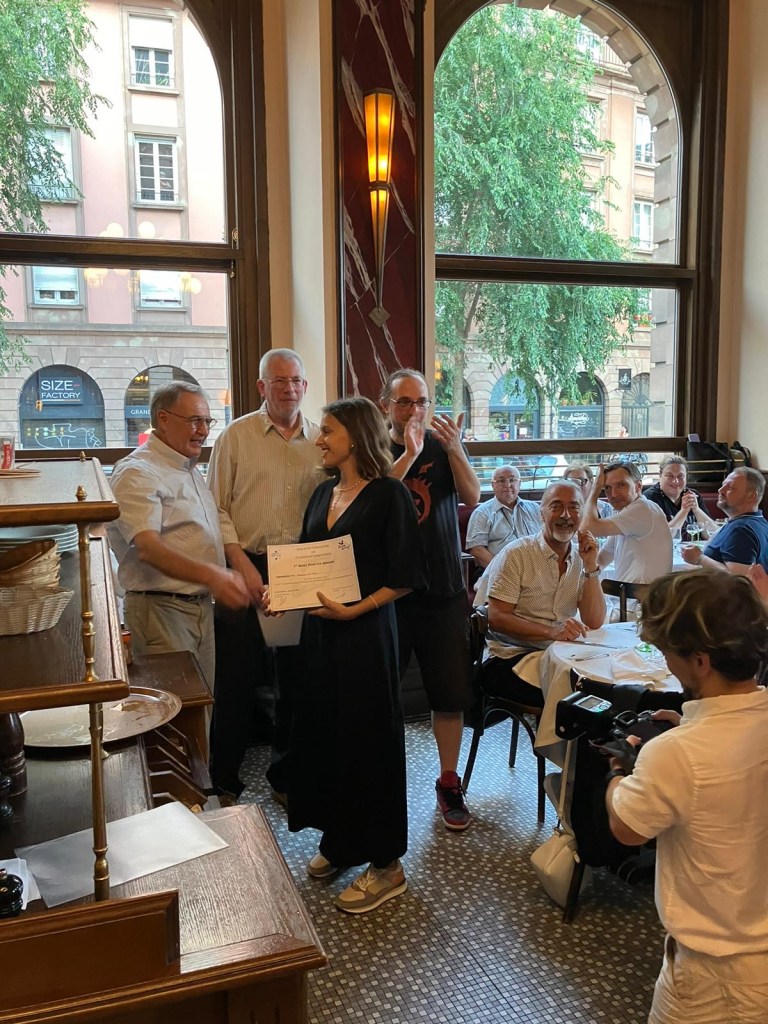
Ariadna Peiro, a PhD student in the Cheminformatics and Nutrition Research Group at Rivira i Virgili University, Spain, was awarded1,858 Euros to attend summer courses at the Strasbourg summer school in Cheminformatics. While there she won the best Poster prize. Her thesis focuses on the fields of virtual screening and drug discovery, with an emphasis on SARS-CoV-2 Proteases. She is involved in a project called NEXT-PANDEMICS that was created after the coronavirus pandemic in response to the vast amount f data generated from vaccine and antiviral research. The main objective of the project is to develop new open-source tools to enhance the effectiveness of virtual screening and predict binding affinity in silico. Additionally, these tools will be applied to determine a list of leads to search for antivirals. Moreover, this discovery would be applied to Zika and Dengue viruses.
Nils van Staalduinen, a PhD candidate at the Institute for Physical Chemistry, RWTH Aachen Germany, was awarded 4,530 Euros that will be allocated as follows: financial support for research visits to the laboratory of Professor Todd Martinez for the integration of MolBar into the Nanoreactor at Stanford University (CA) and payment of travel expenses to attend two conferences – the 2024 German Cheminformatics Conference and the 2024 RDKit UGM. His research concentrates on MolBar, a molecular identifier for chemical structure databases. MolBar was launched in March 2024 and has since been downloaded several hundred times. He balances his PhD work with a role at BASF SE, where he further develops chemical database pipelines with a focus on cheminformatics algorithms that streamline molecule registration and tautomer searchers.
Ivan Yankov, a PhD student at the University of Strathclyde (U.K), was awarded 2,815 Euros in support of his travel for a month-long visit to the BioNMR group, ETH Zurich where he will be extending his research. In addition, he will present his research findings at a related conference. His research is focused on integrating Artificial Intelligence (AI) methods into computational design across drug discovery, drug development, and structure determination of biological materials, with the goal of accelerating in-silico design pipelines by modelling thermodynamic properties of nucleic acids and their complexes.
2023
David Dalmau Ginesta, who was developing cheminformatics and machine learning tools applicable to various sectors of computational chemistry, was awarded $2,100 to attend two international conferences (the RSEQ XXXIX Biennial Meeting in Zaragoza (Spain), June 25-29, 2023, and the ACS fall national meeting in San Francisco (USA), August 13-17, 2023.
Heidi Klem, who received her PhD from Colorado State University (USA) in June 2023 and was selected to be a National Research Council postdoctoral associate at the U.S. National Institute of Standards and Technology (NIST) as of August 2023, was awarded $3,700 to spend a month visiting Professor Zhongyue John Yang at Vanderbilt University, Nashville, TN (USA) for one month. Prof. Yang is the SC Family Dean’s Faculty Fellow and an Assistant Professor of Chemistry, Chemical Engineering, and Data Science.
Dr. Md Bin Yeamin, a postdoctoral fellow at the University of Girona, researching dual catalysis in alkyne functionalization and predictive catalysis in hydrogenation and CO2 fixation, was awarded.
$1,330to be used towards a month-long research stay at the Alegre group at ISQCH Institute of CSIC-Universidad de Zaragona to launch a collaborative project on predicting catalytic performances and reaction mechanisms from data-driven automated machine learning (ML) methods and to give an oral presentation at the XXXIX Biennial Meeting – Spanish Royal Society of Chemistry (RSEQ) 2023 under the symposium S15. Recent trends in organometallic Reactivity.
2022
Dr. Juan V. Alegra Requena, of the University of Zaragoza, Spain where he was establishing his own research group focusing on computational mechanisms and Machine Learning, was awarded
$1,892 for travel to present his work at the RSEQ XXXVIII Biennial meeting in Granada, Spain in June, 2022 and the 8th EuChemS Chemistry Congress in Lisbon, Portugal in September 2022.
Dr. Beatrice Chiew is a postdoc at the University of Newcastle, Australia, where she was
working on drug development in the space of Dynamin endocytosis inhibitors, was awarded $4,034 to present her work at the Royal Australian Chemistry Institute National Congress in July 2022 and the EFMC International symposium on medicinal chemistry in September 2022.
2021
Call for Grant proposals not circulated due to the pandemic.
2020
Daniel Csókás, a member of Professor Imre Pápai’s research team at the Research Centre for Natural Sciences, Budapest, Hungary was awarded $,4000 to travel to the University of Bristol (UK) to expand the scope of his experience in computational chemistry and to acquire new skills and research techniques in the area of data-led catalyst design. The project will involve the creation of a ligand knowledge base for tridentate ligands using calculated descriptors. The database will then be processed to retrieve structural and reactivity information about tridentate ligands and their transition metal complexes. The award is pending the lifting of travel restrictions due to the pandemic.
Andrew Tarzia, a Research Associate at the Imperial College London, was awarded $3,500 to visit Asst. Prof. Cory Simon at Oregon State University for three weeks in 2021 to initiate a collaboration in the use of machine learning algorithms to predict host-guest finding affinities based upon molecular shapes. The award is pending the lifting of travel restrictions due to the pandemic.
Nicola Knight, an Enterprise Research Fellow – Physical Sciences Data-Science Service (PSDS) at the University of Southampton (UK) where she works with the newly-established national research facility to provide access to chemistry and physical sciences data at a national scale and to increase not only the breadth of the data, but also the ways in which the data can be used by the scientific community. She was awarded $2,500 to fund efforts related to a knowledge sharing retreat that will involve four early-career researchers (ECRs) from a cross section of research domains to participate in a 3-day workshop on the depiction of chemical information using the FAIR principles.







 Chemical Structure Association Trust