Summer 2024 Newsletter for RSC CICAG Published

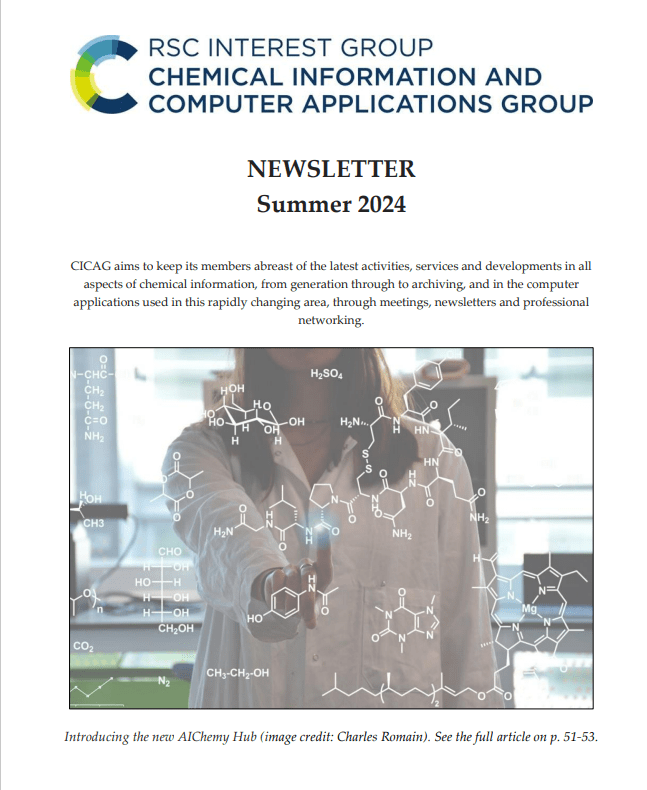
RSC Interest Group: Chemical Information and Computer Applications Group (CICAG) aims to keep its members abreast of the latest activities, services and developments in all aspects of chemical information, from generation through to archiving, and in the computer applications used in this rapidly changing area, through meetings, newsletters and professional networking.

RSC CICAG publish a Newsletter quarterly to keep members in touch with the Group’s activities and includes articles, reviews of interest, news and events. The Summer 2024 issue of the newsletter contains 97 pages. Dr. Helen Cooke FRSC is the Newsletter Editor, and she does an excellent job! Selected articles of potential interest include:

  • Cheminformatics: A Digital History – Part 5. Cheminformatics at Indiana University by Dr. Gary D. Wiggins
  • 100 Years of Markush by Dr Anne Jones and Stuart Newbold
  • Molecule Normalisation with InChI and SMILES Processing by Prof. Jonathan M. Goodman, Prof. Yusuf Hamied, and Vincent F. Scalfani
  • Dr George W.A. Milne (‘Bill’ Milne), 1 May 1937 – 22 November 2023, by Dr. Wendy Warr

Note: Prof. Jonathan M. Goodman, Vincent F. Scalfani, and Dr. Wendy Warr are CSA Trustees.

Chemical Information and Computation 2023, Number Two. Fall 2023 ACS National Meeting in San Francisco

I am excited to announce the upcoming issue in my renowned report series. My reports are essential reading if you want to keep up to date with recent developments in cheminformatics and computational chemistry. As usual, I have transcribed technical presentations in detail, and have added value by including web links, expanding abbreviations, correcting errors, and carefully checking the literature references. License the current report and you will benefit from reading about symposia with these themes:

  • machine learning and AI in chemistry
  • AI and predictive analytics for chemical reactions
  • algorithm development and data analysis in chemical space
  • helping chemists manage their data
  • cheminformatics: toward democratization and open science
  • enhance your data: smart ways to metadata and knowledge graphs.

The report starts with news of recent developments at 50 organizations in the computational chemistry, cheminformatics, chemical information, and publishing markets, plus news about people, awards, and more. Posters and more material appear in appendices. Waste no time. Order now for delivery at the beginning of March 2024.

The 50% discount for academia and government continues, and within large organizations, academic or industrial, licensees can share the report with hundreds, or even thousands of colleagues for little more than twice the basic price.

The contents list is at https://www.warr.com/morepubs.html.

Order forms are at https://www.warr.com.

Dr. Wendy A. Warr

Report by Wendy Warr on Herman Skolnik Award Symposium 2023 Honoring Patrick Walters is Freely Available

At the ACS National Fall Meeting for 2023, Patrick Walters received the Herman Skolnik Award for his contributions to the fields of chemical information and cheminformatics applied to computer-aided drug discovery research. A report about talks given at this award symposium was written for the ACS CINF Chemical Information Bulletin by Wendy Warr (wendy@warr.com) where it is scheduled to appear in March 2024. This report is also freely available from her website.

Learn more:

Oral presentations at this award symposium

  • New ways of working. How virtual compound generators and retrosynthesis prediction are changing the way we work. Speaker: Clara Christ of Bayer, Germany (with co-authors Yannic Alber, Hans Briem, Michael Hahn, Gary Hermann, Florian Koelling, Mario Lobell, Georg Mogk, Florian Mrugalla, and Michael Schimeczek).
  • Complementing the medicinal chemists’ toolbox with cloud-based deep learning models. Speaker: Barry Bunin of Collaborative Drug Discovery (CDD).
  • Unlocking the potential of computational chemistry via integration of tools, data, and people. Speakers: Yakov Pechersky, Eric Manas of Treeline Biosciences.
  • Hierarchical splitting: a novel method for data splitting that improves model performance in real-world drug discovery. Speaker: Ankit Gupta, Reverie Labs.
  • Binding structures and strengths through generative machine learning. Speakers Hannes Stärk and Bowen Jing of Massachusetts Institute of Technology.
  • Machine learning in computer-aided drug discovery is harder than you might think. Speakers: Ajay Jain and his co-author Ann Cleves are Vice Presidents of Research and Application Science, respectively, of the BioPharmics Division of Optibrium.
  • Molecular modeling evolves beyond metrics of similarity. “A sea-change into something rich and strange.” Speaker: Anthony Nicholls of OpenEye, Cadence Molecular Sciences.
  • A rising tide lifts all boats. Speaker: Georgia McGaughey of Vertex Pharmaceuticals.
  • Explainable machine learning in drug discovery. Speaker: Jürgen Bajorath of the University of Bonn, Germany.
  • Tributes to Pat Walters. Speaker: Mark Murcko of Relay Therapeutics.
  • Artificial intelligence in drug discovery: revolution, evolution, or complete nonsense. Speaker: Pat Walters of Relay Therapeutics gave the award address.

“Cheminformatics: A Digital History ‒ Part 4. Ladies First” by Wendy Warr

“In Part 4 of this historical series of articles, I am honoured to follow in the distinguished company of Peter Willett, Henry Rzepa and Johnny Gasteiger, all of whom had a significant influence on me during my progress in the path of cheminformatics. I started out as a synthetic organic chemist. When I matriculated at Oxford in Michaelmas 1964 the ratio of women to men Oxford undergrads in all subjects was 1:5. (At Cambridge it was 1:7, but Cambridge had only 2-3 women’s colleges then, while Oxford had five.) I was one of seven women in total from the five Oxford colleges who studied for chemistry Part I in 1964-1967. I don’t know how many men there were, but the number was certainly over 200. A great deal of progress has since been made as regards equality. On the Oxford undergraduate course in 2023 there are 421 men (57%) and 317 women (43%). There is also a web page about women in chemistry. Jonathan Goodman tells me that third years reading chemistry at Cambridge in Michaelmas 2023 are about 40% female.

I was at Lady Margaret Hall, Oxford, whose undergraduates were always addressed as ‘ladies’: hence the title of this article. One of my sons says that women have been the dark matter of science: they have always been there and are immensely important, but they have only recently been recognised. In 1964, when I went up to Oxford, Dorothy Crowfoot Hodgkin won the Nobel Prize in Chemistry, the first woman winner since the Curies early in the century. Historically, eight out of 191 chemistry Nobel Laureates have been women, but things are improving: five of the eight winning women were recognised in 2009 or later.”

Read the full text: RSC CICAG Newsletter Winter 2023-24, pages 46-50. (PDF)

Bonnie Lawlor Elected to ACS Board of Directors

We are thrilled to announce that Bonnie Lawlor was elected to the ACS Board of Directors. Bonnie became a Board Member of the CSA Trust in 1990, and since 2002 has also served as Chair for the Grants Committee and as Secretary of the CSA Trust. Congratulations, Bonnie!

In her candidate statement that was published in C&EN about why choose Bonnie Lawlor as the District III Director for the ACS Board, she noted:

“I believe that I will bring valuable expertise to the ACS Board of Directors. I served as the executive director of a nonprofit member organization for more than a decade, successfully managing membership retention and growth, motivating volunteers, and balancing member benefits with fiscal responsibility. My extensive publishing experience provides an understanding of the global issues that threaten ACS’s essential revenue from information products and services, and from a financial perspective, my management positions (and MBA) have provided significant profit and loss hands-on experience. Additionally, I have served as an ACS volunteer for decades, know the organization well, and am willing to work hard for you. For more information on my experience and skills, see the following article: garfield.library.upenn.edu/essays/v15p280y1992-93.pdf.”

For more information, please see: