InChI Version 1.07 Approved

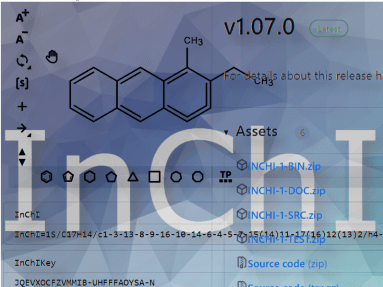
IUPAC InChI moves to GitHub to support sustainable chemical standards development

“The InChI (International Chemical Identifier) is a widely used standard chemical identifier that enables the connection and interoperability of chemistry data across the web. The core code and development framework of the InChI has now been migrated to GitHub, providing a foundation to support future extensions of the standard and associated applications, and to broaden the expertise supporting the standard. The first milestone of this work is the 1.07 version, recently approved by IUPAC (International Union for Pure and Applied Chemistry) and the InChI Trust and available for download at GitHub.

The InChI has been used to identify unique chemical structures for over 20 years and is implemented in chemistry toolkits and in databases across the world. The work to maintain and develop the software rested on the shoulders of one expert, Igor Pletnev, and following his sad death in 2021, it became urgent to move the code to a more open model. Completion of this move with a new fully tested and approved release makes the development of this digital standard more transparent. It will also enable the extension of the InChI to further classes of chemical compounds, in particular inorganic and organo-metallic compounds, as well as future modernisation of the codebase.”  

Read more: InChI Trust News Release, July 16, 2024.

“For over 20 years, InChI (International Chemical Identifier) has uniquely identified chemical structures in databases, journal articles, and supplier catalogues, across the web. It helps quickly determine if a chemical compound in a library is present in an internal repository or match data about chemical compounds across different databases. Reliable standards like InChI are essential for the FAIR principles (Findable, Accessible, Interoperable, Re-usable) in chemical data exchange.”  

Read more: Fit for Future: InChI Standard Moves to GitHub. ChemistryViews, July 28, 2024.

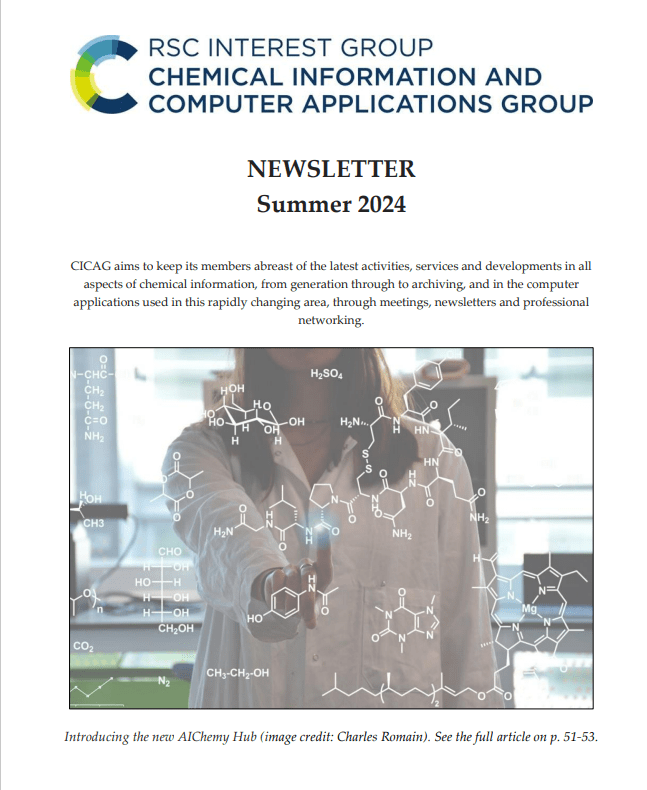
Summer 2024 Newsletter for RSC CICAG Published

RSC Interest Group: Chemical Information and Computer Applications Group (CICAG) aims to keep its members abreast of the latest activities, services and developments in all aspects of chemical information, from generation through to archiving, and in the computer applications used in this rapidly changing area, through meetings, newsletters and professional networking.

RSC CICAG publish a Newsletter quarterly to keep members in touch with the Group’s activities and includes articles, reviews of interest, news and events. The Summer 2024 issue of the newsletter contains 97 pages. Dr. Helen Cooke FRSC is the Newsletter Editor, and she does an excellent job! Selected articles of potential interest include:

  • Cheminformatics: A Digital History – Part 5. Cheminformatics at Indiana University by Dr. Gary D. Wiggins
  • 100 Years of Markush by Dr Anne Jones and Stuart Newbold
  • Molecule Normalisation with InChI and SMILES Processing by Prof. Jonathan M. Goodman, Prof. Yusuf Hamied, and Vincent F. Scalfani
  • Dr George W.A. Milne (‘Bill’ Milne), 1 May 1937 – 22 November 2023, by Dr. Wendy Warr

Note: Prof. Jonathan M. Goodman, Vincent F. Scalfani, and Dr. Wendy Warr are CSA Trustees.

CSA Trust 2025 Mike Lynch Award – Call for Nominations

The Chemical Structure Association Trust is calling for nominations for the 2025 Mike Lynch Award. The deadline is September 30, 2024.

The CSA Trust is an internationally recognized, registered charity that promotes education, research, and development in fields related to chemical structures and cheminformatics.

The Mike Lynch Award recognizes and encourages outstanding accomplishments in education, research, and development activities that are related to the systems and methods used to store, process, and retrieve information about chemical structures, reactions, and properties. The awardee will receive an honorarium and memento and will be invited to make a presentation at the 13th International Conference on Chemical Structures (ICCS) that is scheduled to take place June 1-5, 2025 in Noordwijkerhout, Netherlands.

To nominate an individual, please submit (a) a summary of the nominee’s accomplishments and the specific relevant work that is to be recognized (maximum one page);  (b) a brief biographical sketch, including a statement of academic qualifications and contact information; and (c) at least one seconding letter that supports the nomination and provides additional factual information with regard to the scientific achievements of the nominee. If appropriate, a list of the nominee’s publications and/or patents may also be submitted. The Award will not be given in any year in which the nominees do not meet the award criteria. Work that has not previously been recognized by other awards will usually be given particular consideration.

Please email these documents to the Secretary of the CSA Trust at chescot@aol.com by September 30, 2024.

Nominations will be reviewed by the CSA Trustees, and the awardee will be announced prior to the 13th International Conference on Chemical Structures (ICCS).

Mike Lynch is the Professor Emeritus in the Information School of the University of Sheffield, England, and is an acknowledged cheminformatics pioneer. The Mike Lynch Award was instituted in 2002, and the previous winners listed below received their awards and made presentations at the triennial International Conference on Chemical Structures in Noordwijkerhout:

2022: Greg Landrum: in recognition of his work on the development of RDKit and his fostering of the community around it, a transformative software resource for cheminformatics and machine learning.

2018:  Rudy Potenzone: 40+ year career as a provider of in-house informatics services and a creator and implementer of innovative informatics software solutions including SciFinder.

2014“InChI Team,” Steve Heller, Alan McNaught, Igor Pletnev, Steve Stein, Dmitrii Tchekhovskoi: conception and development of the IUPAC International Chemical Identifier InChI.

2011Engelbert Zass: lifetime career devoted to education in chemical information with an emphasis on database searching and the role of the intermediary.

2008Alexander (Sandy) Lawson: major contributions to chemical information handling and structure representation, particularly in the development of the Beilstein database and software.

2005:  Johann Gasteiger: outstanding accomplishments in the fields of computational chemistry and structure elucidation.

2002Peter Willett: pioneering work in maintaining and nurturing an academic centre of excellence in cheminformatics teaching and research with an emphasis on computational techniques for the processing of chemical and biological information.

13th International Conference on Chemical Structures: Call for Papers

The 13th International Conference on Chemical Structures (ICCS) will be held from 1st – 5th of June 2025 at the beautiful Conference Center in Noordwijkerhout, The Netherlands.

It will continue a well-established conference series that begun in 1973 as a workshop on Computer Representation and Manipulation of Chemical Information sponsored by the NATO Advanced Study Institute and thereafter was held under its new name every third year starting in 1987.

The 2025 conference will build on the experience of the past successful editions to offer a strong scientific program which covers all aspects of cheminformatics and molecular modeling, including for example structure-activity relationships, virtual screening, modeling metabolite networks, etc.

Participants discuss research as well as relevant technological and algorithm developments in handling and visualization of chemical structure data, workflows for complex cheminformatic analysis and machine learning. The conference fosters cooperation among organizations and researchers involved in the increasingly interwoven fields of cheminformatics and bioinformatics and combines in-depth technical presentations with ample opportunities for one-on-one discussions with the presenters.

The ICCS is seeking presentations of novel research and emerging technologies for the following Plenary Sessions.

  • Advanced Cheminformatics Techniques
  • Molecular Similarity and Diversity Analysis
  • Chemical Literature and Patent Mining
  • Spectroscopy and Structure Elucidation
  • (Automated) Reaction Handling and Optimization

Papers may be based on method and algorithm development as well as applications and case studies. Highest standards of scientific quality and validation of results will be required.

Scientific Topics

Advanced Cheminformatics Techniques
     o Molecular Similarity and Diversity Analysis
     o Chemical Literature and Patent Mining
     o Spectroscopy and Structure Elucidation
     o (Automated) Reaction Handling and Optimization

 Artificial Intelligence, Machine Learning, and QSAR
     o Consensus, Federated Learning, and Uncertainty Quantification
     o Advances in Large Language Models for Chemistry
     o Synthetic Accessibility and Retrosynthesis Planning
     o Multi-objective and Many-objective Optimization in Drug Design

 Integrative Structure-Based Drug Design
     o Molecular Dynamics and Free Energy Calculations
     o Structure-based and Rational Drug Design Innovations
     o Modeling Complex Protein Interactions
     o Computer-Assisted Protein Design and Engineering

 New Modalities and Large Chemical Data Sets
     o Design, Profiling, and Comparison of Compound Collections
     o Advances in DNA Encoded Libraries
     o Covalent inhibitors and PROTACS
     o Biologics and oligonucleotides

 Open Science, Omics, and Natural Products
     o Open Access Publishing and Collaborative Platforms
     o Findable, Accessible, Interoperable, and Reusable (FAIR)
     o Advances in X-omics
     o Natural Product Drug Discovery

They also welcome contributions in other aspects of the computer handling of chemical structure information, such as:
       o automatic structure elucidation
       o combinatorial chemistry and diversity analysis,
        o electronic publishing
        o MM or QM/MM simulations
        o modeling of ADME properties
        o material sciences
        o analysis and prediction of structures,
        o grid and cloud computing in cheminformatics

From the submissions, the program committee and the scientific advisory board will select around 30 papers for the plenary sessions. All submissions that cannot be included in the plenary sessions will be automatically considered for the poster sessions.

Mike Lynch Award

The CSA Trust Mike Lynch Award is given on a triennial basis to recognize and encourage outstanding accomplishments in education, research and development activities that are related to the systems and methods used to store, process and retrieve information about chemical structures, reactions and properties. Traditionally the award is presented on the opening night of the ICCS. CSA Trust 2025 Mike Lynch Award – Call for Nominations. Deadline is 31 August 2024. | Previous Recipients

The ICCS Conference is jointly supported by:

  • Division of Chemical Information of the American Chemical Society (ACS)
  • Chemical Structure Association Trust (CSA Trust)
  • Division of Chemical Information and Computer Science of the Chemical Society of Japan (CSJ)
  • Computers in Chemistry Division of the German Chemical Society (GDCh)
  • Royal Netherlands Chemical Society (KNCV)
  • Chemical Information and Computer Applications Group of the Royal Society of Chemistry (RSC)
  • Swiss Chemical Society (SCS)

Important Dates

  • 1 July 2024 – First call for papers
  • 1 October 2024 – Second call for papers
  • 6 January 2025 – Final call for papers
  • 14 February 2025 – Abstract submission deadline
  • 27 April 2025 – End of early registration
  • 25 May 2025 – Registration closes
  • 1-5 June 2025 – 13th ICCS

Social media



2024 CSA Trust Grant Report by Ariadna Peiro

Thanks to the CSA Trust Grant, I had the opportunity to attend the 9th Strasbourg Summer School in Chemoinformatics (CS3-2024). This renowned event, held in the European Capital city of Strasbourg, offered enriching lectures and hands-on tutorials covering the latest topics in the field.

The program offered diverse perspectives on Artificial Intelligence in chemistry, addressed the validation needs in working on Big Data, and shared innovative workflows. It also explored new trends in Quantitative Structure-Activity Relationship (QSAR) modeling and in silico pharmacology, featuring insights from leading international scientists.

As a doctoral candidate in Chemoinformatics and Bioinformatics, focusing on Drug Discovery, I recently achieved a milestone by publishing an open-source program named PDB-CAT (PDB Classification and Analysis Tool). This tool is the first automated, open-source solution designed for classifying structures in the Protein Data Bank.

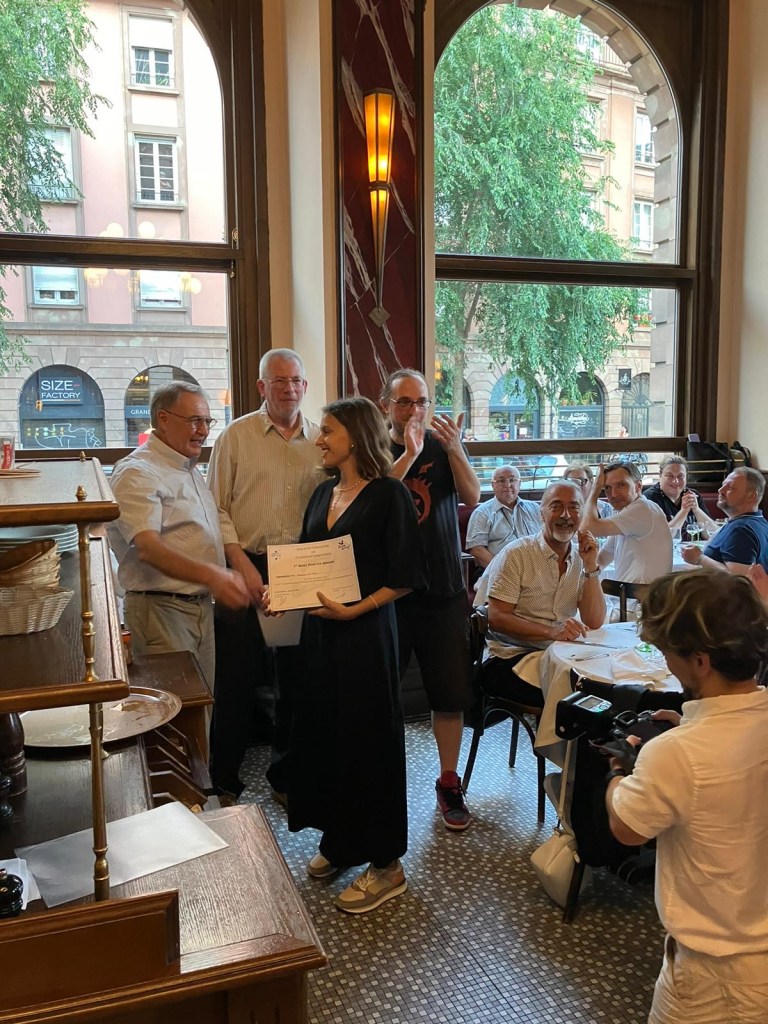
One highlight of my participation was presenting a poster announcing the publication of PDB-CAT. To my delight, my work was recognized with the Best Poster Prize.

Beyond the technical knowledge, attending this international workshop significantly enhanced my soft skills. The motivational environment drove my dedication to my research.

Moreover, the city of Strasbourg, with its rich history and vibrant culture, added a special touch to this unforgettable experience. The beautiful surroundings provided a perfect setting, making the entire journey even more memorable.

In conclusion, the 9th Strasbourg Summer School in Chemoinformatics was more than just an academic event. It was a transformative experience that expanded my comfort zone and solidified my commitment to advancing the field of Drug Discovery. As I continue my doctoral journey, I carry with me the invaluable insights, skills, and personal relationships gained from this opportunity.

CSA Trust Grant Awardees 2024

Nils van Staalduinen (left), Ivan Yankov (middle), Ariadna Peiro (right)

Nils van Staalduinen is a PhD candidate at the Institute for Physical Chemistry, RWTH Aachen Germany where he works under the guidance of Prof. Bannwarth, focusing on theoretical chemistry and cheminformatics. His research concentrates on MolBar, a molecular identifier for chemical structure databases. His current work is an extension of his Master’s thesis for which he won the MSE Master Award of RWTH Aachen. MolBar was launched in March 2024 and has since been downloaded several hundred times. He balances his PhD work with a role at BASF SE, where he further develops chemical database pipelines with a focus on cheminformatics algorithms that streamline molecule registration and tautomer searchers.

His CSA Trust grant funds will provide financial support for research visits to the laboratory of Professor Todd Martinez (see: https://mtzweb.stanford.edu) for the integration of MolBar into the Nanoreactor at Stanford University (CA) and for payment of travel expenses to attend two conferences – the 2024 German Cheminformatics Conference and the 2024 RDKit UGM.

Ivan Yankov is currently a PhD student at the University of Strathclyde (U.K). His research is focused on integrating Artificial Intelligence (AI)  methods into computational design across drug discovery, drug development, and structure determination of biological materials. The goal is to accelerate in-silico design pipelines by modelling thermodynamic properties of nucleic acids and their complexes. Furthermore, AI NMR data analysis systems can be fine-tuned to nucleic acid and nucleic acid ligand complexes to eliminate inefficiencies and reproducibility challenges in the structure determination process from NMR data. The innovation will eliminate bottle necks in the in-silico design and structure determination stages.

Ariadna Peiro, is currently a PhD student in the Cheminformatics and Nutrition Research Group at Rivira i Virgill University, Spain. Her thesis focuses on the fields of virtual screening and drug discovery, with an emphasis on SARS-CoV-2 Proteases. She is involved in a project called NEXT-PANDEMICS that was created after the coronavirus pandemic in response to the vast amount of data generated from vaccine and antiviral research. The main objective of the project is to develop new open-source tools to enhance the effectiveness of virtual screening and predict binding affinity in silico. Additionally, these tools will be applied to determine a list of leads to search for antivirals. Moreover, this discovery would be applied to Zika and Dengue viruses.  CSA Trust Grant funds will be used to attend summer courses at the Strasbourg summer school in Cheminformatics.

Chemical Information and Computation 2023, Number Two. Fall 2023 ACS National Meeting in San Francisco

I am excited to announce the upcoming issue in my renowned report series. My reports are essential reading if you want to keep up to date with recent developments in cheminformatics and computational chemistry. As usual, I have transcribed technical presentations in detail, and have added value by including web links, expanding abbreviations, correcting errors, and carefully checking the literature references. License the current report and you will benefit from reading about symposia with these themes:

  • machine learning and AI in chemistry
  • AI and predictive analytics for chemical reactions
  • algorithm development and data analysis in chemical space
  • helping chemists manage their data
  • cheminformatics: toward democratization and open science
  • enhance your data: smart ways to metadata and knowledge graphs.

The report starts with news of recent developments at 50 organizations in the computational chemistry, cheminformatics, chemical information, and publishing markets, plus news about people, awards, and more. Posters and more material appear in appendices. Waste no time. Order now for delivery at the beginning of March 2024.

The 50% discount for academia and government continues, and within large organizations, academic or industrial, licensees can share the report with hundreds, or even thousands of colleagues for little more than twice the basic price.

The contents list is at https://www.warr.com/morepubs.html.

Order forms are at https://www.warr.com.

Dr. Wendy A. Warr

Report by Wendy Warr on Herman Skolnik Award Symposium 2023 Honoring Patrick Walters is Freely Available

At the ACS National Fall Meeting for 2023, Patrick Walters received the Herman Skolnik Award for his contributions to the fields of chemical information and cheminformatics applied to computer-aided drug discovery research. A report about talks given at this award symposium was written for the ACS CINF Chemical Information Bulletin by Wendy Warr (wendy@warr.com) where it is scheduled to appear in March 2024. This report is also freely available from her website.

Learn more:

Oral presentations at this award symposium

  • New ways of working. How virtual compound generators and retrosynthesis prediction are changing the way we work. Speaker: Clara Christ of Bayer, Germany (with co-authors Yannic Alber, Hans Briem, Michael Hahn, Gary Hermann, Florian Koelling, Mario Lobell, Georg Mogk, Florian Mrugalla, and Michael Schimeczek).
  • Complementing the medicinal chemists’ toolbox with cloud-based deep learning models. Speaker: Barry Bunin of Collaborative Drug Discovery (CDD).
  • Unlocking the potential of computational chemistry via integration of tools, data, and people. Speakers: Yakov Pechersky, Eric Manas of Treeline Biosciences.
  • Hierarchical splitting: a novel method for data splitting that improves model performance in real-world drug discovery. Speaker: Ankit Gupta, Reverie Labs.
  • Binding structures and strengths through generative machine learning. Speakers Hannes Stärk and Bowen Jing of Massachusetts Institute of Technology.
  • Machine learning in computer-aided drug discovery is harder than you might think. Speakers: Ajay Jain and his co-author Ann Cleves are Vice Presidents of Research and Application Science, respectively, of the BioPharmics Division of Optibrium.
  • Molecular modeling evolves beyond metrics of similarity. “A sea-change into something rich and strange.” Speaker: Anthony Nicholls of OpenEye, Cadence Molecular Sciences.
  • A rising tide lifts all boats. Speaker: Georgia McGaughey of Vertex Pharmaceuticals.
  • Explainable machine learning in drug discovery. Speaker: Jürgen Bajorath of the University of Bonn, Germany.
  • Tributes to Pat Walters. Speaker: Mark Murcko of Relay Therapeutics.
  • Artificial intelligence in drug discovery: revolution, evolution, or complete nonsense. Speaker: Pat Walters of Relay Therapeutics gave the award address.

“Cheminformatics: A Digital History ‒ Part 4. Ladies First” by Wendy Warr

“In Part 4 of this historical series of articles, I am honoured to follow in the distinguished company of Peter Willett, Henry Rzepa and Johnny Gasteiger, all of whom had a significant influence on me during my progress in the path of cheminformatics. I started out as a synthetic organic chemist. When I matriculated at Oxford in Michaelmas 1964 the ratio of women to men Oxford undergrads in all subjects was 1:5. (At Cambridge it was 1:7, but Cambridge had only 2-3 women’s colleges then, while Oxford had five.) I was one of seven women in total from the five Oxford colleges who studied for chemistry Part I in 1964-1967. I don’t know how many men there were, but the number was certainly over 200. A great deal of progress has since been made as regards equality. On the Oxford undergraduate course in 2023 there are 421 men (57%) and 317 women (43%). There is also a web page about women in chemistry. Jonathan Goodman tells me that third years reading chemistry at Cambridge in Michaelmas 2023 are about 40% female.

I was at Lady Margaret Hall, Oxford, whose undergraduates were always addressed as ‘ladies’: hence the title of this article. One of my sons says that women have been the dark matter of science: they have always been there and are immensely important, but they have only recently been recognised. In 1964, when I went up to Oxford, Dorothy Crowfoot Hodgkin won the Nobel Prize in Chemistry, the first woman winner since the Curies early in the century. Historically, eight out of 191 chemistry Nobel Laureates have been women, but things are improving: five of the eight winning women were recognised in 2009 or later.”

Read the full text: RSC CICAG Newsletter Winter 2023-24, pages 46-50. (PDF)

Bonnie Lawlor Elected to ACS Board of Directors

We are thrilled to announce that Bonnie Lawlor was elected to the ACS Board of Directors. Bonnie became a Board Member of the CSA Trust in 1990, and since 2002 has also served as Chair for the Grants Committee and as Secretary of the CSA Trust. Congratulations, Bonnie!

In her candidate statement that was published in C&EN about why choose Bonnie Lawlor as the District III Director for the ACS Board, she noted:

“I believe that I will bring valuable expertise to the ACS Board of Directors. I served as the executive director of a nonprofit member organization for more than a decade, successfully managing membership retention and growth, motivating volunteers, and balancing member benefits with fiscal responsibility. My extensive publishing experience provides an understanding of the global issues that threaten ACS’s essential revenue from information products and services, and from a financial perspective, my management positions (and MBA) have provided significant profit and loss hands-on experience. Additionally, I have served as an ACS volunteer for decades, know the organization well, and am willing to work hard for you. For more information on my experience and skills, see the following article: garfield.library.upenn.edu/essays/v15p280y1992-93.pdf.”

For more information, please see: